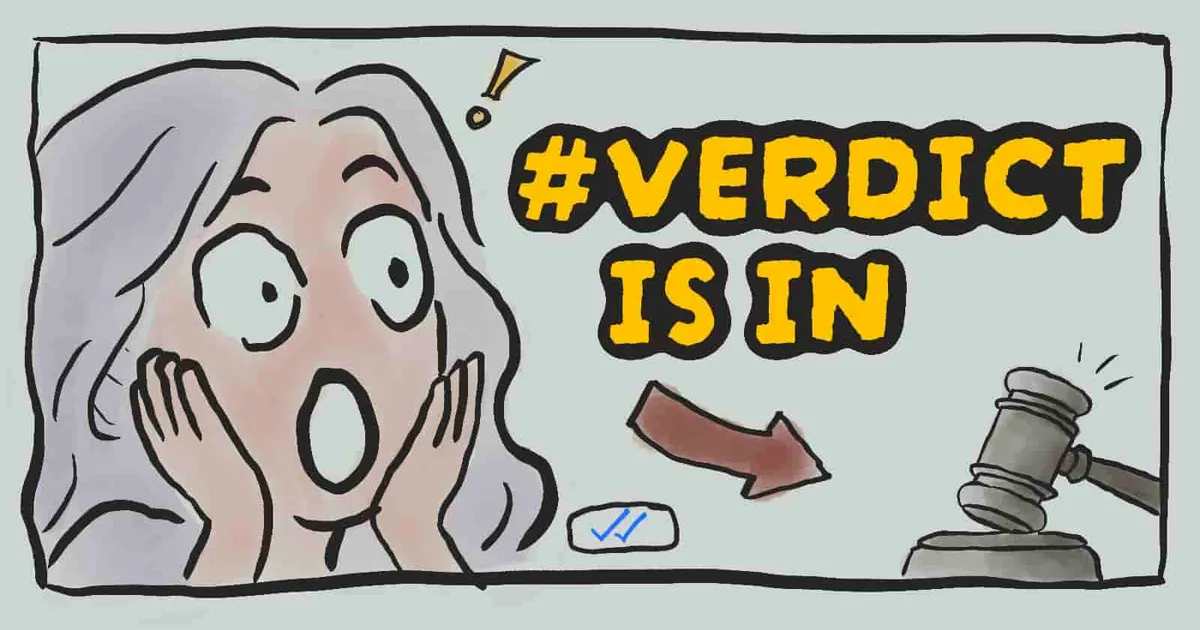
The subtle product features that worked too well, unfortunately.
The court of unintended consequences is now in session. Please take a seat.
As a product manager, I understand. As a user, I would like to press charges.
Defendant 1: The Infinite Scroll
You stand accused of removing the end of things.
You entered my life around 2006 disguised as a solution for the “page 2 problem” of search results and blog rolls. The defence argues that pressing “Next” and pagination was inconvenient. Now you have taken over social media and gave rise to doomscrolling. You even infiltrated the television with your partner in crime, Netflix’s autoplay feature.
I used to decide whether to continue. Now I have to decide when to stop. To quote the philosopher BoJack Horseman, “There is always more show (until there isn’t)”
I sentence you to a lifetime watching of The Shawshank Redemption, where the film always ends with the tunnel opening into another prison.
Defendant 2: The Hashtag
You stand accused of turning a town square into a billboard.
You emerged from the obscurities of IRC chat conventions and found your way into mainstream on Twitter in 2007. You were a helpful label; a way to find conversation about my niche interests. You bolstered the “long-tail”. Then you became a distribution strategy. “This belongs here” became a desperate “Please show this everywhere”.
I wanted to share a sunset. Why am I researching keywords?
I sentence you to community service, but your hours begin once you find your community using hashtags.
Defendant 3: The Thumbnail
You stand accused of continuing to sell me something I was already going to buy.
You used to be a still frame from my YouTube video in the 2010s. The court acknowledges that misleading “hot girl” thumbnails are as old as Youtube, and custom thumbnails were a reasonable solution to more accurately represent a video. Somehow, now every thumbnail on my feed has a shocked face, a red arrow, and a promise. I click. But now a 60 second “highlight reel” of that video is promising me that the promise will eventually be fulfilled.
I’m here. You won. Please begin.
I sentence you to a lifetime of meals at a restaurant where the waiter describes your meal for twenty minutes before serving it.
Defendant 4: The Read Receipt
You stand accused of converting silence into information.
You had a respectable career in email for tracking delivery before you hopped over to WhatsApp in 2014 in the form of the “blue ticks”. Suddenly, opening a message became an obligation. I opened my friend’s message while buying groceries and didn’t reply. The blue ticks now suggest that I have rejected them as a person. Your accomplice, the “typing…” indicator, makes even composing a reply a spectator sport.
To ensure that my silence doesn’t send a message, I have become skilled at reading message previews from my mobile notification drawer without opening them (unless a ‘previewed’ feature is in the works).
I sentence you to a front door that tells visitors you’re home, you heard them knock, and you’ve started walking towards the door, then stopped.
The defence points out that these features solve real problems. The prosecution admits to using all four. Given a tidy problem statement and a promising experiment, I might have approved them myself. Let the record show that I find this sentencing difficult.
The court is adjourned. Unless you explicitly say no, we will autoplay the next hearing in five, four, three, two…